Entrada original en español aquí.
PHOTOS
Almaty and surroundings ( 317 photos )
Charyn Canyon and Black Canyon ( 107 photos )
Lakes Kaindy and Kolsai ( 134 photos )
Tamgaly Petroglyphs ( 133 photos )
VIDEOS
Charyn Canyon (3’58")
On the way to Lake Kaindy in "Bukhanka" (UAZ-452) (4’58")
Lagos Kaindy y Kolsai (20´11¨)
Route to see the Tanbaly Petroglyphs (3’50")
Tamgaly Petroglyphs (12’02")
Shymbulak cable car and Kök Töbe cable car (3´05¨)
Statue of the Beatles. Kök Töbe (1´20¨)
GPX ROUTES
East Route (Almaty – Charyn Canyon – Black Canyon – Lake Kaindy – Lake Kolsai – Almaty)
Western Route (Almaty – Tamgaly Petroglyphs – Kök Töbe – Medeo – Chimbulak – Almaty)
Total Route = East Route + West Route
LOGISTICS
Outbound flight – February 14, 2026 – Air Asia X D7-600
Kuala Lumpur T2 (12:35) – Almaty (17:40) – Direct flight of 8h05´
Return flight – February 17, 2026 – Air Asia X D7-601
Almaty (19:00) – Kuala Lumpur T2 (06:00+1) – 8h direct flight.
There is a 3-hour time difference between KL and Almaty; 6pm in KL is 3pm in Almaty.
Flights purchased with Traveloka .
Hotel in Almaty (3 nights):
The Mini Hotel on 154 Mukanova Street.
CHRONICLE OF THE JOURNEY
In the Malaysian work calendar, Tuesday, February 17th, and Wednesday, February 18th, 2026, were marked as public holidays for the Chinese New Year, also known as the Lunar New Year. School gave us Monday off, so we had a five-day weekend, which we had to make the most of.
After living in Shanghai for five years and Jakarta for five, I felt like I was a bit familiar with this part of the world and was keen to visit a new country. I looked into which airlines offered direct flights from KL and to where, and finally decided on Almaty, Kazakhstan, an eight-hour direct flight. I had the Lonely Planet Central Asia guide with me from my trip to Uzbekistan two years earlier, so organizing things wouldn’t be too difficult. I bought the flights three weeks in advance, on January 24th.
I have the Lonely Planet guide in English, so I’ll copy the text from that language. In the section "Why go to Kazakhstan?" it says the following:
¨The world´s ninth-biggest country is the most economically advanced of the ¨stans¨, thanks to its abundant reserves of oil and most other valuable minerals. This means generally better standards of accommodation, restaurants and transport than elsewhere else in Central Asia. The biggest city, Almaty, is almost reminiscent of Europe with its leafy avenues, chic ALZhiR Museum-Memorial Complex, glossy shopping centres and hedonistic nightlife. The capital Astana (Nur-Sultan), on the windswept northern steppe, has been transformed into a 21st-century showplace with a profusion of bold futuristic architecture. But it´s beyond the cities that you will find the greatest travel adventures, whether hiking in the high mountains and green valleys of the Tian Shan, searching for wildlife on the lake-dotted steppe, enjoying homespun hospitality in village guesthouses, or jolting across the western deserts to remote underground mosques¨.
Regarding Almaty, Lonely Planet says the following:
¨Population 1.7 million / Elevation 850m
The leafy city of Almaty (Alma-Ata), with a backdrop of the snowcapped Zailiysky Al-atau, has always been among the more appealing Russian creations in Central Asia. Today Almaty´s new rich have expensive suburban apartments, large SUVs, glitzy shopping malls, Western-style coffee lounges, expensive restaurants, dance-till-dawn nightclubs and new ski resorts to help them enjoy life to the full. Meanwhile, others from the city´s outer districts and the countryside squeeze into packed buses and rickety marshrutkas around the Green Market (Zelyony Bazar) o Sayakhat bus station.
Almaty is Kazakhstan´s main transport hub and a place many travellers pass through. Stay a few days and you´ll find that it is a sophisticated place -one for enjoying green parks and excellent museums, shops and markets, and for eating, drinking and partying in Central Asia´s best selection of restaurants, cafes, bars and clubs. And great mountain hiking and skiing are right on the doorstep.
History
Almaty was founded in 1854, when the Kazakhs were still nomads, as a Russian frontier fort named Verny, on the site of an old Silk Road oasis called Almatu, which had been laid waste long before by the Mongols. Cossacks and Siberian peasants settled around Verny, but the town was almost flattened by earthquakes in 1887 and 1911. In 1927 it became the capital of Soviet Kazakhstan, with the name Alma-Ata (Father of Apples). The Turksib (Turkestan-Siberia) railway arrived in 1930 and brought big growth -as did WWII, when factories were relocated here from Nazi-threatened western USSR and many Slavs came to work in them. Numbers of ethnic Koreans, forcibly resettled from the Russian Far East, arrived too.
In the 1970´s and ´80s Kazakhstan´s leader Dinmukhamed Kunayev, the only Central Asian member of the Soviet Politburo, managed to steer lots of money southeast from Moscow to transform Alma-Ata into a worthy Soviet republican capital. Hence the number of imposing late-Soviet building such as the Arasan Baths, the Hotel Kazakhstan and the Academy of Sciences.
In 1991 Alma-Ata was the venue for the meeting where the USSR was finally pronounced dead and all five Central Asian republics joined the Commonwealth of Independent States. The city´s name was changed to Almaty, close to that of the original Silk Road settlement, soon afterwards.
Almaty was replaced by Astana as Kazakhstan´s capital in 1998 but remains the country´s business, social and cultural hub. Office towers, apartment blocks and shopping centres continue to push skyward, especially in the south of the city¨.
Okay, we’re learning a little more. Before the trip, if you had asked me about Kazakhstan, I would have answered Aleksandr Vinokourov or the Astana cycling team .
DAY 1: KUALA LUMPUR – ALMATY. Saturday, February 14, 2026
Outbound flight – February 14, 2026 – Air Asia X D7-600
Kuala Lumpur T2 (12:35) – Almaty (17:40) – Direct flight of 8h05´
Flight went smoothly. I didn’t check any luggage; I only had my school backpack as hand luggage. Checking a bag with Air Asia would have cost extra, and as young people say these days, " it wasn’t worth it ." Alpine-style tourism.
I arrive at the airport and these are the logical steps to follow:
1.- Politely get rid of taxi drivers.
Like in many countries, as soon as you step outside you’ll find people still calling you "taxi." Ugh, sorry man, I need time to do things at the airport... and I don’t know if the fare will be worth it.
2.- Exchange money.
I did it at the currency exchange offices at the airport. Some people prefer to withdraw money from ATMs using cards like Wise or Revolut.
The illuminated sign in the currency exchange office read:
Dollars:
-Buy (492 tenges)
-Turns (498 turns)
Euros:
-Buy (585 tenges)
-Turns (591closed)
3.- SIM local para tener datos.
With Kazakh tenge you can now buy a local SIM for your phone.
I have an old phone that doesn’t support eSIM. But I know that people with eSIM are thrilled; they do everything online before landing, it’s cheaper, and they have data as soon as they arrive in the country.
If, like me, you have a phone that doesn’t support eSIM, you’ll have to buy a physical SIM (or get a new phone). And it’s easy to buy a SIM at the airport. You just go to one of the kiosks and they’ll install it for you. The sign advertising the tariff was interesting:
"Unlimited internet for one month, 5G."
-6000 tenges or 12 euros or 12 dollars¨.
Depending on the currency you used, you would pay more or less. That day, looking at the online currency converter XE , 6000 tenge = 12.13 dollars = 10.22 euros. Therefore, the best currency to pay in was:
1.- in dollars
2.- a pair of pliers
3.- in euros
4. Taxi app – YandexGo
This app also worked in Uzbekistan, and it’s like Uber around the world or Grab in Malaysia. You order a taxi through the app, it tells you the price, and that’s it. You don’t have to haggle, and you know they won’t charge you more for being a tourist. I used it a few times in Kazakhstan, and it’s very efficient, so download it.
With data and the YandexGo app on my mobile, I ordered a taxi to the hotel.
The hotel I booked was The Mini Hotel on 154 Mukanova Street. It’s not in the very center of Almaty; you’d need a taxi to get there, but it wasn’t far. The reason I booked this hotel for three nights is that I had a tour booked for the next day at 5:00 AM. The meeting point was Kazakh State Circus , at Abay Avenue 50. It was about a 2.5-kilometer walk, and when I made the booking, I didn’t want to risk having to rely on a taxi to get there, just in case. I could have booked anywhere, since I’d seen that YandexGo worked very well.
Also, on the app where I book hotels (Agoda) I saw that there were many apartments to rent, but I liked going to a hotel where you could leave your things at reception when checking out, etc.
I really liked the hotel and the area it was in. Far enough from the center to be quiet, but close to everyday shops and restaurants.
I arrived at the hotel, dropped off my backpack, and went for a walk exploring the neighborhood, which was covered in snow. Cool!
DAY 2: ALMATY – CHARYN CANYON – BLACK CANYON – LAKE KAINDY – LAKE KOLSAI – ALMATY. Sunday, February 15, 2026.
That day I had to get up early. I had booked a tour to visit the places mentioned in the title, and the meeting time was 5:00 a.m. Around 4:15 a.m., I left for a walk there, about 30 minutes. I had to be careful because of the ice.
The tour I booked can be done over two days, staying overnight outside Almaty, in nature. I didn’t book it for two days because there were no dates available; I would have. The one-day tour is intense. We started at 5:00 a.m. and returned to the same spot at 9:00 p.m., after a long drive. But honestly, it didn’t feel long at all; what we saw was amazing. A bus was waiting for us at the meeting point, and about 30 tourists boarded. Some were from China, others from Central Asia, and still others from other Asian countries. I was the only European; it wasn’t the right time of year to travel to that continent. The guide gave us instructions and explanations, first in Russian, then translated them into English. These were the places we visited:
1.- CHARYN CANYON
It is located about 200 kilometers from Almaty.
This is how the Lonely Planet guide describes it:
¨Sculpted by the wind, water and sun over millions of years, and some 300m deep in places, Charyn Canyon is Kazakhstan´s answer to the Grand Canyon, with some truly spectacular and varied landscapes. There are the red rock formations of the Valley of Castles, the canyon´s most popular destination -reminiscent of Utah or Arizona, with a dirt road snaking down to the fast flowing, glacial Charyn River¨.
It is home to a small rodent, the large jerboa ( Rhombomys opimus ), which appears in videos and photos of the canyon.
2.- BLACK CANYON
After visiting Charyn Canyon, we took a bus about 30 kilometers to see Black Canyon, which is part of that National Park. Its dark volcanic rocks contrast with the red formations of Castle Valley.
3.- LAGO KAINDY
From there we headed to Lake Kaindy, about 70 kilometers from Black Canyon. It’s a wonderful journey there, because after getting off the bus you take an off-road van, ride a horse for part of the way, and then walk the last part.
¨Bukhanka¨- UAZ-452
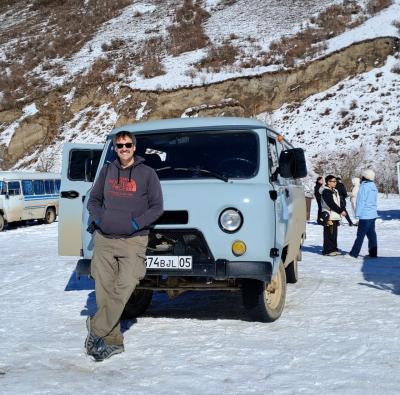
The bus stopped in a village called Saty . There we boarded UAZ-452s, affectionately known as "Bukhanka" (loaf of bread), a legendary Soviet off-road vehicle born in the 1960s. Robust, simple, and practically indestructible, it was designed to tackle the toughest terrain of the steppe, mountains, and snow. My favorite 4x4 used to be the Toyota Hilux, but after seeing this beast in action, I’ve changed my mind. Here you can see a video of this vehicle in action, off the beaten path.
On horseback
After riding in a bukhanka for a while, we arrived at a spot not far from the lake, where we were given two options: either walk to the lake or go on horseback. I opted for the latter. We were in a group, with the horses running loose, but at one point I found myself completely on my own, no one in front, no one behind, just the snow-capped mountains of Kazakhstan. It was wonderful! There wasn’t much danger—I say this because I don’t know how to ride—because we had to go from point A to point B along a path the horses had traveled a thousand times and knew perfectly well. At one point, my horse stopped, neither going forward nor backward. I tried to encourage it, but nothing worked; we just stayed put. Finally, a Kazakh man passed by, and with a few noises from his mouth, the animal continued on its way.
During the journey, I reviewed the places in the world where I had ridden a horse, and the following came to mind:
- China , Qingqing Resort Village (Shanghai), September 26, 2010.
- Mongolia , Terelj Natural Park, October 3, 2010.
- Tibet , Lake Yamdrok Yumco, June 17, 2013 (it was a yak, not a horse).
- Indonesia , Bromo Volcano, March 27, 2018.
-India, Kashmir Great Lakes Trek, 27 julio 2022.
- Bhutan , Tiger’s Nest, October 28, 2023
- Kazakhstan , Lake Kaindy, February 15, 2026
With that I edited the following video: " On horseback around the world " (3’52")
On foot.
The horses are left behind, and the last stretch is done on foot. In some sections there are boardwalks, and the horses couldn’t go there. A lovely walk through the snow.
Lake Kaindy sits at an altitude of about 2,000 meters and was formed by a massive limestone landslide triggered by an earthquake in 1911, creating a natural dam. The characteristic sight is the submerged tree trunks protruding from the surface. I had seen photos of the lake as green, though not in winter, but I found it white, covered in a layer of ice and snow. This Reddit post shows a photo from other seasons and describes the place well. I copy and paste it here:
English:
¨Lake Kaindy is located in the south of Kazakhstan, within Kolsai Lakes National Park. It is located 2,000 metres (6,600 ft) above sea level, 130 kilometres (81 mi) east of Almaty. The lake was formed as the result of a major limestone landslide triggered by the 1911 Kebin earthquake forming a natural dam. It blocked the gorge and was filled by mountain river water. Lake Kaindy is about 400 meters long, reaching depths of nearly 30 meters at its deepest point. Altered by limestone deposits, the water maintains a bluish-green color.
The lake contains trunks of submerged Picea schrenkiana trees that rise above the surface of the lake. The area is often referred to as a "sunken forest". The cold water helps preserve the tree trunks, which are overgrown with algae and various other water plants. In recent years, Lake Kaindy has become a popular international tourist destination. The lake is also known for ice diving and trout fishing in the winter season.
The uniqueness of the lake lies in the fact that after the emergence of a natural dam that blocked the gorge, the water that filled the dam formed the lake and did not destroy the spruce trees growing in this place along the river. (The Kaindy river flows into the lake, passing through a two-sided rock face about 20 meters high). The upper part of the trees protruding from the water lost their side branches and bark, and the wood turned white. When you look at such a panorama, you get the feeling that you are looking at a submerged squadron: the bare trunks of trees resemble the masts of submerged ships. The lake surface itself changes color regularly and is often a very beautiful blue color. This strange color is caused by lime and other minerals that were in the water a hundred years ago. But as soon as you get closer to the lake, the water becomes crystal clear, and sometimes you can even see trout in it. Despite the low water temperature, Kaindy lake is popular with diving enthusiasts.
Legend has it that at Midnight, if you stare at your reflection in the Lake and say Kaindy Man 3 times the Spirit of the only casualty of the land slide, a young Kazakh Shepherd Boy name Kaindy Khan will come and take you to the Depths below.¨
Interesting. From there, the little girl walked back to the horse, returned on the animal’s back, and then back to Saty by bukhanka, where we ate wonderful local dishes.
4.- LAGO KOLSAY
After lunch we went to Lower Kolsay Lake, located at about 1,800 meters. Unlike Kaindy, it’s not a single lake, but a system of three cascading alpine lakes. Looking at the scenery, you could easily mistake it for Switzerland or Canada.
Before visiting, I looked up pictures online. What I found, as with Kaindy, was very different, because at this time of year those lakes are frozen and covered in snow. The contrast of the white with the dark green of the fir forests surrounding their shores is striking.
------
That was the last visit of the day. Now there were about 280 kilometers (about 4 hours) left to get back to Almaty. The drive was pleasant, taking in the snowy landscapes of the steppe. Around 9 pm we arrived back at the meeting point from that morning, and I walked back to the hotel instead of taking a taxi.
A fantastic tour!
DAY 3: ALMATY – PETROGLIFOS DE TAMBALY – ALMATY (KÖK TÖBE, ZENKOV CATHEDRAL, …). Monday, February 16, 2026.
1.- PETROGLIFOS DE TAMBALY
The plan for the day was to visit the Tambaly Petroglyphs , a UNESCO World Heritage Site, located about two and a half hours (165 kilometers) from Almaty. The site contains more than 5,000 petroglyphs dating from the Bronze Age to the modern era. And if, like me, you need to review what dates we’re talking about with the Bronze Age, in Central Asia we’re talking about around 2000 BC (earlier in Europe and the Near East). This means that here we find petroglyphs dating back 3,000 years, spanning different periods up to the modern era.
To avoid getting confused, I booked a tour . It was not cheap, which is a disadvantage, but it had its great advantages:
-I went alone with a guide.
-We didn’t find absolutely anyone there.
-It was something I wanted to see, so it was a must.
I had seen good reviews online about the guide, Nursultan, from the Neomad agency. We had already been in contact and he was supposed to pick me up at the hotel this morning at 8:00.
The day before, he wrote me the following message:
¨Good day Mr.Castro,
This is Nursultan from Neomad.
Mr.Castro, I have some news regarding the tour tomorrow. Due to the weather conditions yesterday/today the highway which we need to take has been partially closed, because of the thick fog and snow on the road near the Tanbaly. The situation is changing depending on the time of the day.
Tomorrow the weather forecast is better, and I hope there won’t be problems like that. But anyways there is some chance, so I have to let you know.
I will monitor the situation today and will check it again in the morning, before meeting you. In case it will be closed, we can do it on the other day if that is possible for you. If there won’t be any suitable alternatives we will make a full refund for you.
I am sorry for such inconvenience. Can’t predict such things unfortunately.
I will keep you updated.
You can share your WhatsApp contact for a quicker communication. Here is my WhatsApp just in case,
Kind regards,
Nursultan¨
I thanked them for the message, for keeping me updated, and for offering the option to reschedule or receive a refund. I told them that if we couldn’t make it on the planned day, we could do it the next day, as long as I could get to the airport in time for my return flight (I only had my backpack, so it was easy). We stayed in touch via WhatsApp, and they finally confirmed that we would stick to the original plan.
On the route (you can see it in this video ) it is clear that there was quite a lot of snow the day before, as Nursultan indicated.
Before we continue, here’s my recommendation. If you visit the Tanbaly petroglyphs, don’t hesitate to contact Nursultan directly (this is his WhatsApp number, with his permission: +77770150276) or book a tour through his agency, Neomad .
During the drive, I asked him a bunch of questions that came to mind, and he answered them. One of them was about driving in the snow. He told me that from October/November to February/March, they have to switch to winter tires (it’s mandatory). And those tires work well in the snow.
I saw that too when I was in Argentina , in Ushuaia, the southernmost city in the world. There are permanent settlements further south, like Puerto Toro (population 22), on the Chilean island of Navarino south of Ushuaia, or the bases in Antarctica, but they don’t meet the criteria for a city as an urban area, fulfilling certain population and service requirements. It was July 2015, their winter, and everything was covered in snow. I took a taxi to Cerro Marcial and was amazed by the cars in the snow. People were driving as if it were a dry summer day in Spain. Without a problem. And the key is those winter tires.
We stopped at a rest stop along the way and bought some local food. A type of milk caught my eye; the vendor explained what it was and offered me a taste. It was kumis , and I drank a bowlful with some kind of grain. I liked it. Kumis is made exclusively from fermented mare’s milk. Mare’s milk is richer in sugars than cow’s milk, which allows for a more intense fermentation. It has a sweet and sour, refreshing flavor and, due to the fermentation process, a small amount of alcohol, generally between 0.7% and 2.5%. It’s much more than just a drink in Kazakhstan; it’s a national symbol of nomadic culture and a cornerstone of its cuisine.
Continuing along the route , we were stopped by the police for a routine check. Nursultan got out without any problems; they just checked his papers and everything was in order. A police officer came to talk to me, nothing more.
The route to Tambaly involves a highway to a town called Targap (about 95 kilometers from Almaty) and from there a local road to Tambaly (about 60 kilometers). When we got onto the local road, which was quite snowy, we came across a herd of large, very cool camels. We also passed a couple of flocks of sheep on the road. Horses are a common sight in Kazakhstan, especially when traveling by road.
Speaking of horse meat, Nursultan told me that if you asked people in Kazakhstan about their favorite meat, 90% would say mare’s meat. While discussing the country’s nomadic history, he mentioned something very interesting. The livestock the nomads transported were sheep and horses, but not cattle. For a couple of reasons:
-One obvious difference is speed. Cows move more slowly.
-The other one isn’t so obvious. He told me that when it snows and there’s no pasture, sheep and horses can use their hooves to move the snow and look for food, but cows don’t seem to do that.
We arrived at the petroglyph interpretation center, a huge, empty building with only a couple of staff members. No more were needed, because there was no one else there. It was very well set up, with explanatory signs and display cases—a wonderful place that seemed completely underutilized. A panel explained how, on September 19, 1957, an expedition from the Academy of Sciences of the Kazakh Soviet Socialist Republic, led by archaeologist Anna Georgievna Maximova, identified the immense importance of the site. Local shepherds had always known of the existence of these rocks, but they were unknown to science. The original certificate declaring it a World Heritage Site is also housed in this museum.
From there we drove a few kilometers back to the entrance, and then it’s a walk. It’s an open-air museum with a vast number of engravings that depict the worldview of ancient nomadic peoples through hunting scenes, rituals, and animals. The iconic "solar deities," or beings with sun heads, are particularly noteworthy.
It was a true privilege to have this vast space all to ourselves, Nursultan and me. No tourists, no locals. Just the two of us. His explanations were fascinating.
Regarding visiting a World Heritage Site without crowds, I had a similar experience in Iran, visiting Persepolis back in December 2007. This is what I wrote on my blog :
"I arrived there around 8:20 a.m. on December 27th, in freezing cold. The advantage: there were only four of us tourists, each doing our own thing, in an area of 125,000 square meters. What a treat, right? To be able to enjoy this in peace and quiet. So I strolled through the different palaces, staircases, and tombs. Yes, there are two tombs carved into the rock, like Petra in Jordan. I went to see the museum, but they told me it was closed because there was no electricity. I wandered leisurely from one place to another, reading about everything I was seeing, and around 10:30 a.m., when more people were starting to arrive, I changed my plans."
The feeling of visiting a place like this without people is absolutely incredible.
I had a wonderful experience in Iran, undoubtedly one of my favorite trips. On Saturday, February 28, 2026, the US and Israel attacked that country, with Iran’s subsequent response targeting the opposing forces in the Middle East.
I have no sympathy for the governments of any of the three countries mentioned.
But I do have a lot of sympathy for the people of Iran, who treated me wonderfully, and they certainly deserve a much better situation than the one they have been suffering.
The petroglyphs of Tanbaly reminded me somewhat of the rock paintings of Bhimbetka . While in India, after reading Javier Moro’s novel "It Was Midnight in Bhopal," I visited Bhopal. In that state, Madhya Pradesh, there is also another World Heritage Site, the Bhimbetka Rock Paintings ( photos ). The difference is that these in India are paintings, like those in the Altamira cave, but those in Tanbaly, Kazakhstan, are petroglyphs; they are carved into the rock. Otherwise, with the harsh climatic conditions of the steppe, the paintings probably wouldn’t have survived to our time. I’m including this from what I wrote on my blog :
From there I headed to the Bhimbetka Rock Paintings, a World Heritage Site.
"In 1957, the Indian archaeologist Wakanker discovered more than 1,000 rocks carved into a sandstone cliff near Bhimbetka, surrounded by a deciduous forest. More than 500 were covered with paintings executed with bold, energetic lines, very similar to the cave paintings of Lascaux in France or the Kalahari cave paintings in Africa. The oldest, from the Upper Paleolithic period, depict large animals, such as bison and rhinoceroses, painted with red pigment, while human figures are green. Most of the paintings are from the Mesolithic period (8000 to 5000 BC) and depict scenes of daily life, hunting, and animals. Later caves (1st century AD) show scenes of battles and Hindu deities. They were declared a World Heritage Site in 2003."
To visit the caves I hired the services of a guide.
After visiting the petroglyphs, we returned to Almaty. I asked Nursultan if he minded dropping me off at Tök Köbe instead of my hotel, and he said no problem, so off we went.
2.- ROOT BOTTOM
This is how the Lonely Planet guide describes this place:
¨(Green Hill) This 1100m hill on the city´s southeast edge is crowned by a 372m-high TV tower visible from far and wide, and affords great views over the city and the mountains, plus an assortment of attractions at the top. The easy way up is by the smooth cable car.
At the top you will find several cafes and restaurants, craft shops, a roller coaster, a minizoo, and ¨I Heart Almaty¨ sign, a children´s playground and life-sized bronze statue of the four Beatles, placed here on the initiative of local fans in 2007. The work of Almaty sculptor Eduard Kazaryan, this is claimed to be the world´s only monument showing all the Fab Four together. You can sit beside a guitar-strumming John on the bench¨.
Translated into Spanish:
When I see anything about the Beatles , I often think of Tiffany , a very nice student I taught during my last year at Shanghai American School, back in 2012-13. She was in 11th grade. She liked to write and had self-published a few books. The following year, she mailed me her latest book, about the Liverpool band, to Jakarta, where she was working at the time.
That summer of 2015, I was traveling to Argentina (I mentioned Ushuaia above), and while making preparations, I discovered that Buenos Aires is home to the only Beatles museum in South America, and apparently the one with the most artifacts. I asked Tiffany what she thought about leaving a copy of her book at the museum, and she said she’d be delighted. So I did, as I describe in this blog post.
So when I came across this statue, I had to record the following video message for it (1’21"):
"Go Tiffany!"
This is Castro, your old teacher, and I’m in Almaty, Kazakhstan, and I thought of you, of course! Because look what I found here: a bronze statue of The Beatles. Here are the Fab Four, with John sitting with his guitar—you can sit with him—and an explanation that’s in Russian, or Kazakh; we can’t make any sense of it.
But I’ve done a little research and it says this statue was erected in 2007 because fans in Kazakhstan wanted it, and they commissioned it from a Kazakh sculptor, Eduard Kazaryan, and here it is. It must be the only one in the world with all four Beatles life-size. So, one more thing.
Okay, a big hug, I hope everything goes really well for you!
3.- PANFILOV PARK
I took the cable car down and walked to Panfilov Park. There stands the Cathedral of the Ascension , better known as Zenkov Cathedral, named after the architect and engineer Andrei Zenkov, who oversaw and implemented the seismic engineering in 1904. He did a remarkable job, because after the devastating 1911 earthquake, which measured 8.2 on the Richter scale, this was one of the few tall buildings that remained standing. Why? Thanks to its flexible wooden structure and a foundation system that acted as a natural shock absorber. Legend and guidebooks say that the cathedral is built entirely of wood without a single metal nail. This isn’t entirely true. The reality is that, although it’s a feat of timber engineering, some metal reinforcement elements were used. But yes, the main structure is a puzzle of perfectly assembled Tien Shan fir beams.
When I went it was closed. Next door there was an outdoor ice skating rink.
I continued walking through the center and finally took a taxi home.
DAY 4: ALMATY – MEDEO – CHIMBULAK – ALMATY – KL. Tuesday, February 17, 2026.
Last day in Almaty, we had to enjoy it.
I woke up and took a taxi to the Medeo cable car , about 20 kilometers from the hotel.
This is how the Lonely Planet guide describes Medeo & Chimbulak:
¨Medeo and Chimbulak are Almaty´s wintersports playgrounds in the Malaya Almatinka valley. The facilies were comprehensively upgraded for Almaty´s hosting of the 2011 Asian Winter Games. Medeo, about 15km southeast of central Almaty at an altitude of 1700m, is a scattering of buildings around the huge Medeo ice rink. Chimbulak, further up the valley at 2200m, is Central Asia´s top skiing centre. The two are connected by road and a cable car. Medeo is always several degrees cooler than Almaty, and Chimbulak is cooler still. Except in summer, rain in Almaty means snow and zero visibility at the higher elevations.
What looks like a dam in the main valley above Modeo ice rink is actually there to stop avalanches and mudslides¨.
In Medeo, I was looking forward to visiting the open-air ice rink , which can accommodate 1,000 skaters. It was built in 1972 and can be seen from the cable car up to Chimbulak. But at that time, it was under repair and closed to the public.
I took the cable car to Chimbulak and the ski atmosphere was electric. I snapped some photos, had some rice pudding and coffee, and then took the cable car back down to Medeo. This time I didn’t take a taxi back to the center, but the bus.
Last chance to see some of Almaty. I took a stroll past the Presidential Palace, the City Hall (Maslikhat), the Independence Monument, and then wandered around the streets. I went to the Post Office to mail some postcards, and next door was a music conservatory. I went in to have a look around and there were some girls in the hallway playing strange violins , which, instead of having the neck attached to the narrow part of the violin, had it attached to the wide part. They weren’t even resting them on their shoulders.
With that, I took a taxi to the hotel, picked up my backpack, and went to the airport. This was the return plan:
Return flight – February 17, 2026 – Air Asia X D7-601
Almaty (19:00) – Kuala Lumpur T2 (06:00+1) – 8h direct flight.
-----------------------------------------------------------------------------------
It’s been a fantastic getaway, I’ve enjoyed it a lot.
It’s funny, and it’s not a new feeling. When you’re working, time seems to fly. You start the week, it feels like you haven’t done anything—apart from running—and suddenly it’s Friday. At night you go to sleep and think, "Phew, the day’s already gone." Traveling is different; traveling is another story. You get so much done in a day, you go here, see there, try something else, and the day ends and you say, "Wow, this day feels like two weeks." Anyway, it’s the relativity of time and the comparison between routine and anything outside of the daily grind.