¡Feliz noche mágica de Reyes!
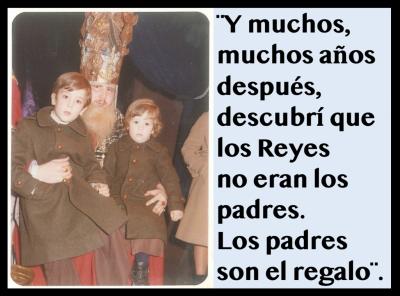
¨Y muchos,
muchos años
después,
descubrí que
los Reyes
no eran los
padres.
Los padres
son el regalo¨.

¨Y muchos,
muchos años
después,
descubrí que
los Reyes
no eran los
padres.
Los padres
son el regalo¨.
En mi caso este año Movember ha durado hasta el 15 de diciembre, que ha sido cuando me he afeitado el bigote.
Ya conocéis la causa. Movember (esta es la página Web en español) es un movimiento que busca concienciar sobre la salud masculina. Se recaudan fondos destinados a programas de investigación centrados en el cáncer de próstata, el cáncer de testículos, la salud mental y la inactividad física. El hecho de dejarse crecer un bigote este mes invita a tener conversaciones sobre el tema.
En el video hago un ¨discurso¨ de Navidad hablando en un idioma raro.
¿Qué digo? Solución en este otro video.
¡Mañana último día del semestre y vacaciones!
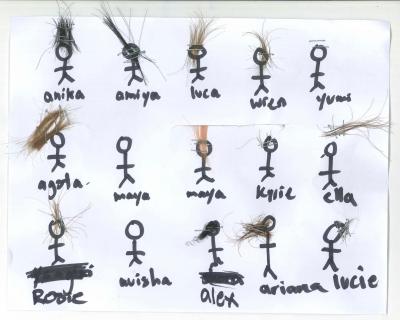
Hoy, durante uno de los cambios de clase, han aparecido dos de mis estudiantes de grado 6 (11 para 12 años) con esta hoja: ¨toma, para que te acuerdes de nosotras en vacaciones¨.
En esta profesión ya sabes que nunca has visto todo…
You could read this blog entry in English here.
Videos:
Maldivas 1/6 (11´23¨) – Pot-pourri – 23-26 noviembre 2023.
Maldivas 2/6 (5´25¨) – Nadando con rayas – Isla de Fulidhoo, 25 noviembre 2023.
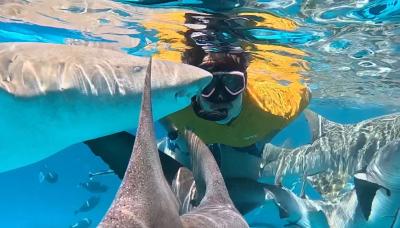
Maldivas 3/6 (6´51¨) – Nadando con tiburones nodriza – 25 noviembre 2023.
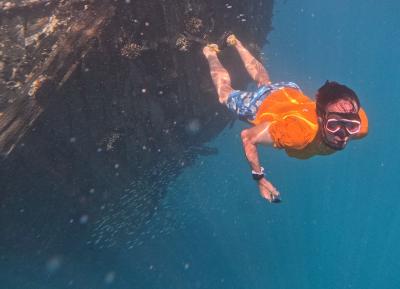
Maldivas 4/6 (3´39¨) – Barco hundido cerca de Keyodhoo. Atolón Vaavu, 25 de noviembre de 2023.
Maldivas 5/6 (2´48¨) – Video Relive 23-26 noviembre 2023.
Maldivas 6/6 (58¨) – Alojamiento en Maafushi – 25 noviembre 2023.
El cuarto jueves de noviembre los estadounidenses celebran el Día de Acción de Gracias.
Mi escuela en Delhi se llama American Embassy School y con ese nombre no puede negar la cruz de su parroquia así que el jueves 23 de noviembre era festivo, con el consiguiente fin de semana de cuatro días. El plan: una escapadita a las Maldivas.
Logística:
Vuelos:
Jueves 23 de noviembre de 2023. Vuelo de Vistara UK273
Delhi T3 (11:55) – Male – Velana International Airport (15:30) – Vuelo directo de 4h05´
Domingo 26 de noviembre de 2023. Vuelo de Vistara UK274
Male – Velana International Airport (16:30) – Delhi T3 (21:05) – Vuelo directo de 4h05´
Alojamiento:
Para 4 días lo quería hacer fácil. Y leyendo la Lonely Planet, una de las opciones más sencillas era la isla de Maafushi. Así la describe la Guía Lonely Planet:
¨Maafushi (población 3030)
El centro de la escena de viajes independientes de las Maldivas, la isla de Maafushi ha experimentado cambios sísmicos desde la apertura de las primeras casas de huéspedes aquí en 2010, y ahora cuenta con más de 50 hoteles y casas de huéspedes. Es fácilmente la isla habitada más cosmopolita y progresista de las Maldivas, y cuenta con una playa para bikinis y un mercado de buceo y excursiones muy competitivo.
Incluso puedes salir de la isla para tomar alcohol en bares flotantes justo fuera del puerto, o hacer una excursión de un día a uno de los muchos resorts cercanos que reciben a huéspedes diurnos en busca de alcohol, cerdo y una actitud más relajada hacia los bañistas semidesnudos.
Maafushi puede que no sea la isla más atractiva, con solo algunas playas buenas que tienden a llenarse, pero está bien ubicada para docenas de excursiones de un día y, sinceramente, la gran cantidad de competencia de casas de huéspedes mantiene los precios asequibles. Bienvenidos a las Maldivas para mochileros".
¡Listo, aquí nos quedamos! Tocaba buscar hotel y busqué una pensión razonable, Chao Guesthouse.
Visado:
No se necesita visado para entrar en las Maldivas.
Pero sí que hay que rellenar un formulario en las 96 horas antes de llegar y de salir.
En ese formulario tienes que indicar en qué hotel te vas a quedar.
Cuando llegué me preguntaron en qué hotel me iba a quedar, y les dije que en Chao Guesthouse. Me dijeron que les enseñara la reserva. Así que sí, hay que ir con reserva hecha.
Eso me recordó a una anécdota cuando viajé a Cuba, hace ya más de 20 años.
Llegué al aeropuerto y hablando con otros turistas en la cola de inmigración comentaron que había que ir con una reserva de hotel hecha. Yo no tenía ninguna. Cuando me preguntó el funcionario de inmigración a qué hotel iba le respondí ¨Hotel Revolución¨. Me lo había inventado y no sabía ni si existía. Me dijo vale, y me estampó el sello de entrada. Luego en un taxi fui a buscar una casa particular.
JUEVES 23 DE NOVIEMBRE DE 2023
Aterrizo en Male. Llevo conmigo dólares, rupias indias y euros.
En llegadas del aeropuerto hay bancos y en el Bank of Maldives voy a cambiar pasta a la moneda local, rufiyaa. Les digo a ver si puedo cambiar rupias indias y me dicen que no, que o dólares o euros. Cambio euros a la moneda local.
En los 4 días que estuve allá pagué en la moneda local en tiendas locales, pero restaurantes, excursiones, ferrys, todo fue en dólares. Así que:
-intentad llevar dólares.
-no cambiéis demasiado a la moneda local, porque los pagos suelen ser en dólares. De todos modos, si cambias en el banco te dan un recibo y a la vuelta, en salidas, puedes cambiar de la moneda local a euros o dólares otra vez (a la moneda que hayas cambiado la primera vez) en una oficina del mismo banco. Si hacéis esto, tened en cuenta lo siguiente:
-Cambias de euros/dólares a rufiyaas en el Bank of Maldives en Llegadas.
-Al irme, quise cambiar de rufiyaas a euros en esa misma oficina. Me dijeron que no era posible. Que tenía que cruzar inmigración y que en el hall de salidas encontraría otra oficina de Bank of Maldives. Me mosqueó un poco porque crucé inmigración, seguridad, llegué al Duty Free y a la zona de restaurantes y ahí no había ningún Bank of Maldives. Luego bajé las escaleras a mi puerta de embarque y ahí sí, estaba el Bank of Maldives. Con el recibo cambié las rufiyaas que me quedaban y listo.
Para llegar del aeropuerto a Maafushi tienes que tomar un barco. Tienes varias opciones:
-Transporte local: lento y barato.
-Lanchas rápidas. Me decante por esta opción. Estas son las páginas Web para la conexión con Maafushi:
--- iCom Tours
--- Maafushi Tours
Salidas Airport-Male-Maafushi:
iCom Tours (25$): 09:00, 10:25, 13:10, 15:25, 18:10, 21:15.
Maafushi Tours: 08:40, 11:40, 14:10, 16:55, 21:30.
Aterricé a las 15:30, cambié pasta y estuve haciendo tiempo paseando por fuera hasta las 18:10 que cogí la lancha rápida. Por cierto, el aterrizaje en las Maldivas es brutal, porque los atolones desde arriba se ven de maravilla. Yo estaba en el asiento de ventana de la izquierda (A), no sé si a la derecha también se verán bien.
Monté al barco y el capitán me preguntó a qué hotel iba. Le dije Chao Guesthouse.
Paramos en Male, que está justo enfrente del aeropuerto, se subió gente y a Maafushi.
En el puerto al bajar había mucha gente de hoteles esperando a sus clientes. Yo había estado en contacto con mi hotel pero en ningún momento hablamos de que me venían a recoger así que fui tranquilamente andando. Llegué y no había nadie en la recepción. Sí que tenían un papel con la clave Wifi así que me conecté y le envié un WhatsApp al del hotel diciendo ¨ya he llegado¨. Apareció por allá y me dijo que me había ido a buscar al puerto en moto, que le había llamado el capitán que iba para allá. Vaya, cosas de la comunicación.
Estando dos días completos (viernes y sábado) tocaba maximizarlos. Hablé con el del hotel para ver si conocía agencias para hacer tours. Me sacó un folleto de Velaa Trips y ahí aparecían las excursiones. Había visitas para pasar el día en resorts pero a mí eso no me molaba demasiado. Selecciones un par de tours:
Tour 1 para el viernes (7:30-16:00)
Snorkel con tiburón ballena
Snorkel con mantas rayas
Visita a la Isla Dhigurah
Almuerzo/Agua/Toalla
Equipo de snorkel
Fotos/Videos submarinos
Tour 2 para el sábado (7:30-15:00)
Snorkel en un barco hundido
Snorkel con tiburones nodriza
Isla Fulidhoo (Atolón Vaavu)
Observación de rayas
Observación de delfines
Banco de arena
Almuerzo/Agua/Toalla
Equipo de snorkel
Fotos/Videos submarinos
El del hotel se ofreció a llevarme en moto hasta la agencia para hacer las reservas y el pago. Guay. El puesto de Veela estaba al lado del puerto, hacia la izquierda. Hechas las reservas el del hotel se ofreció a llevarme en moto de vuelta pero le dije que prefería darme una vuelta tranquilo por las isla, cenar, etc.
VIERNES 24 DE NOVIEMBRE
¡Muy ilusionado por ver tiburones ballena! Había visto videos en Internet y son impresionantes. Es el pez más grande del mundo con aproximadamente 12 metros de longitud. Pese a su tamaño no suponen ningún peligro para los humanos. Quizás os preguntéis ¨¿no es la ballena o la orca el pez más grande del mundo?¨. No, porque pertenecen a un grupo de mamíferos marinos conocidos como cetáceos. Al contrario que los peces, tienen sangre caliente, respiran aire a través de pulmones y dan a luz a crías vivas que se alimentan de la leche materna.
Ya en la barca nos dijeron que habían visto uno el día anterior y que la probabilidad de verlos era alta. Sin embargo dimos vueltas y más vueltas y más vueltas y no vimos ninguno en todo el día. Es lo que tiene la fauna. Lo mismo con las mantas rayas, tampoco vimos ninguno. En un momento apuntaron a unos delfines que yo tampoco llegue a ver. Haciendo snorkel sí que vi una tortuga, y salvo peces de menor tamaño eso fue todo. La salida, en cualquier caso, espectacular por surcar esos mares transparentes con unas variaciones de colores increíbles.
SÁBADO 25 DE NOVIEMBRE
Este día sí, íbamos a tiro hecho.
Nadamos con rayas en la Isla de Fulidhoo (fauna en la isla). Suelen estar por el embarcadero y les dan de comer, así que vienen. También rondaba por ahí un tiburón nodriza y una garza real.
Nadamos con tiburones nodriza en Fuldhoo Shark Point. El tiburón gata o nodriza es un tiburón de boca pequeña, con la que succiona su alimento para triturarlo posteriormente con sus dientes curvos. Es un tiburón generalmente inofensivo. No es agresivo y no representa ningún peligro para el hombre, aunque si se lo provoca puede atacar. En ese punto les llevan dando de comer unos 15 años, así que todos los días vienen, todos los días los turistas nadan con ellos, con lo que están muy acostumbrados a los humanos. Una gozada nadar con ellos.
Navegando navegando se veían diferentes resorts que tenían muy buena pinta. Paramos a comer en un banco de arena, una isla pequeña con solo arena, sin nada de vegetación, de superficie como la de un campo de fútbol. Preciosa. La claridad cuando te metes debajo del agua es impresionante.
De ahí fuimos a hacer snorkel en un barco hundido, cerca de Keyodhoo, en el atolón Vaavu.
El día anterior no vimos mantas rayas, esta vez sí que vimos una.
De vuelta a Maafushi estuve paseando por la isla. Pasé por el Kaani Grand Seaview, que es el hotel en el que se alojaron Edu y Eli en su visita en junio, y pasé también por el hotel Entre Azules, que me había comentado mi primo que llevaba una española. Después, investigando un poco, he visto que ha escrito un libro llamado ¨Entre Azules¨ que estará bien leer para conocer un poco más en profundidad las Maldivas. También esta chica organiza tours en español de una semana a Maldivas. Otra recomendación de mi primo fue probar el helado de coco, y lo que dice Dudu va a misa.
En Maldivas no se vende alcohol, siendo país musulmán. Pero hecha la ley, hecha la trampa, y al lado de Maafushi hay un barco atracado al que se puede acceder en barcas gratuitas desde el puerto. Estuve tentado de darme una vuelta para ver el ambiente pero me dio pereza.
Al lado de mi hotelito estaba la cárcel de Maafushi. Los altos muros no permiten a los presos ver el mar, que triste estando en este lugar tan paradisiaco.
DOMINGO 26 DE NOVIEMBRE
Mi vuelo salía a las 4:30pm así que tenía toda la mañana por delante.
Los horarios del ferry de iCom Tours Maafushi-Male-Aeropuerto eran 8:00, 9:30, 12:00, 14:30, 17:00, 20:00. Cogí el de las 9:30am a Male para darme una vuelta por la capital del país. Estuve visitando la plaza Jumhoore Maidan, la mezquita Grand Friday Mosque, el Museo Nacional, el mercado de frutas y el mercado de pescado. A Maldivas, para 4 días, me había llevado una mochila pequeña que no tenía ni que facturar en el avión, con lo que podía moverme y pasear sin problemas. Con eso, en lugar de coger un taxi o un barco al aeropuerto me fui andando cruzando el puente Sinamalé, que así lo describe esta Web:
¨Uno de los mejores lugares para visitar en Malé es el Puente Sinamale, también conocido como el Puente de la Amistad China-Maldivas, con una longitud de 2.1 km y carriles separados para peatones, autos y bicicletas. Este hermoso puente sobre el precioso mar es una de las principales atracciones en las Maldivas y también establece una conexión entre Malé y el aeropuerto internacional de Hulhule. El Puente Sinamale está financiado por el gobierno chino como muestra de amistad entre los dos países. La hermosa entrada al puente representa de manera notable al islam, junto con la unidad y el nacionalismo de las Maldivas¨.
Ya en el avión tuve de compañeros de asiento a dos maldivos, de 18 y 20 años. Charlando con ellos me dijeron que iban a Delhi, porque tenían una entrevista en el consulado español para conseguir el visado para España. La razón: en enero comenzaban en Madrid un curso de dos años para ser pilotos comerciales. ¡Curioso! Les pregunté a ver si se lo pagaban ellos o estaba subvencionado y dijeron que lo subvencionaba el gobierno maldivo.
Y eso es lo dieron de sí los 4 días por Maldivas. Corto, pero un viaje espectacular.
This blog entry was originally written in Spanish here.
This is a translation into English using ChatGPT.
Videos:
Maldives 1/6 (11´23¨) – Medley – November 23-26, 2023.
Maldives 2/6 (5´25¨) – Swimming with stingrays – Fulidhoo Island, November 25, 2023.
Maldives 3/6 (6´51¨) – Swimming with nurse sharks – November 25, 2023.
Maldives 4/6 (3´39¨) – Sunken ship near Keyodhoo. Vaavu Atoll, November 25, 2023.
Maldives 5/6 (2´48¨) – Relive Video November 23-26, 2023.
Maldives 6/6 (58¨) – Accommodation in Maafushi – November 25, 2023.
The fourth Thursday of November, Americans celebrate Thanksgiving Day. My school in Delhi is called the American Embassy School, and with that name, it cannot deny the cross of its parish, so Thursday, November 23, was a holiday, leading to a four-day weekend. The plan: a little getaway to the Maldives.
Logistics:
Flights:
Thursday, November 23, 2023. Vistara Flight UK273
Delhi T3 (11:55) – Male – Velana International Airport (15:30) – Direct flight of 4h05´
Sunday, November 26, 2023. Vistara Flight UK274
Male – Velana International Airport (16:30) – Delhi T3 (21:05) – Direct flight of 4h05´
Accommodation:
For 4 days, I wanted to keep it simple. And reading the Lonely Planet, one of the easiest options was the island of Maafushi. This is how the Lonely Planet describes it:
"Maafushi (population 3030)
The hub of independent travel scenes in the Maldives, the island of Maafushi has undergone seismic changes since the opening of the first guesthouses here in 2010 and now boasts over 50 hotels and guesthouses. It is easily the most cosmopolitan and progressive inhabited island in the Maldives, featuring a bikini beach and a very competitive diving and excursion market.
You can even leave the island to have alcohol in floating bars just outside the harbor or take a day trip to one of the many nearby resorts that welcome day guests in search of alcohol, pork, and a more relaxed attitude towards semi-nude bathers.
Maafushi may not be the most attractive island, with only a few good beaches that tend to get crowded, but it is well-located for dozens of day trips, and honestly, the abundance of guesthouse competition keeps prices affordable. Welcome to the Maldives for backpackers."
Ready, here we stayed! It was time to find a hotel, and I searched for a reasonable guesthouse, Chao Guesthouse.
Visa:
No visa is needed to enter the Maldives.
But you do need to fill out a form within 96 hours before arriving and departing.
In that form, you have to indicate which hotel you will be staying at.
When I arrived, they asked me in which hotel I was going to stay, and I told them at Chao Guesthouse. They asked to see the reservation. So yes, you have to go with a reservation made.
That reminded me of an anecdote when I traveled to Cuba over 20 years ago.
I arrived at the airport, and while talking to other tourists in the immigration line, they mentioned that you had to have a hotel reservation. I didn't have one. When the immigration officer asked me which hotel I was going to, I replied, "Hotel Revolución." I had made it up, and I didn't even know if it existed. He said okay and stamped my entry seal. Later, in a taxi, I went to find a private house.
THURSDAY, NOVEMBER 23, 2023
I land in Male. I have dollars, Indian rupees, and euros with me.
In the airport arrivals, there are banks, and at the Bank of Maldives, I exchange some currency for the local currency, rufiyaa. I ask if I can exchange Indian rupees, and they tell me no, only dollars or euros. I exchange euros for the local currency.
During the 4 days I spent there, I paid in the local currency at local shops, but for restaurants, excursions, ferries, everything was in dollars. So:
- Try to carry dollars.
- Don't exchange too much into the local currency because payments are usually in dollars. Anyway, if you exchange at the bank, they give you a receipt, and upon return, at departures, you can exchange from the local currency to euros or dollars again (to the currency you exchanged first) at an office of the same bank. If you do this, keep in mind the following:
- Exchange from euros/dollars to rufiyaas at the Bank of Maldives in Arrivals.
- When leaving, I wanted to exchange from rufiyaas to euros at that same office. They told me it wasn't possible. I had to go through immigration, and in the departures hall, I would find another Bank of Maldives office. It bothered me a bit because I went through immigration, security, reached Duty-Free and the restaurant area, and there was no Bank of Maldives. Then, I went downstairs to my boarding gate, and there it was, the Bank of Maldives. With the receipt, I exchanged the remaining rufiyaas, and I was ready.
To get from the airport to Maafushi, you have to take a boat. You have several options:
- Local transport: slow and cheap.
- Speedboats. I opted for this option. These are the websites for the connection to Maafushi:
--- iCom Tours
--- Maafushi Tours
Airport-Male-Maafushi Departures:
iCom Tours ($25): 09:00, 10:25, 13:10, 15:25, 18:10, 21:15.
Maafushi Tours: 08:40, 11:40, 14:10, 16:55, 21:30.
I landed at 15:30, exchanged money, and spent time walking around until 18:10 when I took the speedboat. By the way, landing in the Maldives is amazing because the atolls look wonderful from above. I was in the left window seat (A); I don't know if it's the same on the right.
I boarded the boat, and the captain asked me which hotel I was going to. I told him Chao Guesthouse.
We stopped in Male, which is right in front of the airport; people got on, and we went to Maafushi.
At the port, there were many people from hotels waiting for their clients. I had been in contact with my hotel, but at no time did we talk about them picking me up, so I calmly walked. I arrived, and there was no one at the reception. They did have a paper with the Wi-Fi password, so I connected and sent a WhatsApp to the hotel guy saying, "I've arrived." He appeared and told me he had gone to pick me up at the port on a motorbike; the captain had called him saying he was heading there. Well, communication things.
With two full days ahead (Friday and Saturday), it was time to maximize them. I talked to the hotel guy to see if he knew agencies for tours. He handed me a Velaa Trips brochure, and the excursions were listed there. There were day visits to resorts, but that didn't appeal to me much. I selected a couple of tours:
Tour 1 for Friday (7:30-16:00)
Whale Shark Snorkeling
Manta Ray Snorkeling
Visit to Dhigurah Island
Lunch/Water/Towel
Snorkel equipment
Underwater Photos/Videos
Tour 2 for Saturday (7:30-15:00)
Snorkeling at a Sunken Ship
Nurse Shark Snorkeling
Fulidhoo Island (Vaavu Atoll)
Stingray Observation
Dolphin Watching
Sandbank
Lunch/Water/Towel
Snorkel equipment
Underwater Photos/Videos
The hotel guy offered to take me by motorbike to the agency for reservations and payment. Cool. The Velaa booth was next to the port, to the left. After making the reservations, the hotel guy offered to take me back on the motorbike, but I told him I preferred to take a leisurely stroll around the island, have dinner, etc.
FRIDAY, NOVEMBER 24
Very excited to see whale sharks! I had seen videos on the Internet, and they are impressive. It is the world's largest fish, approximately 12 meters in length. Despite their size, they pose no danger to humans. You might wonder, "Isn't the whale or the orca the largest fish in the world?" No, because they belong to a group of marine mammals known as cetaceans. Unlike fish, they have warm blood, breathe air through lungs, and give birth to live young that feed on maternal milk.
Once on the boat, they told us they had seen one the day before, and the probability of seeing them was high. However, we circled and circled and circled, and we didn't see any all day. That's the way with wildlife. The same with manta rays; we didn't see any either. At one point, they pointed to some dolphins that I didn't manage to see either. While snorkeling, I did see a turtle, and apart from smaller fish, that was all. The outing, in any case, was spectacular, navigating those transparent seas with incredible color variations.
SATURDAY, NOVEMBER 25
This day, we were sure about our plans.
We swam with stingrays at Fulidhoo Island (fauna on the island). They usually gather around the pier and are fed, so they come close. A nurse shark and a heron were also in the vicinity.
We swam with nurse sharks at Fuldhoo Shark Point. The nurse shark is a small-mouthed shark that sucks in its food to later crush it with its curved teeth. It's generally harmless, not aggressive, and poses no danger to humans, although it can attack if provoked. They have been feeding them at that point for about 15 years, so they come every day, and tourists swim with them every day. They are very accustomed to humans, making it a joy to swim with them.
While sailing, we saw various resorts that looked very appealing. We stopped to have lunch on a sandbank, a small island with only sand, no vegetation, with a surface like a football field. Beautiful. The clarity when you dive underwater is impressive.
From there, we went snorkeling at a sunken ship near Keyodhoo, in the Vaavu Atoll.
The day before, we didn't see manta rays, but this time we did.
On the way back to Maafushi, I walked around the island. I passed by Kaani Grand Seaview, which is the hotel where Edu and Eli stayed during their visit in June. I also passed by Entre Azules, the hotel my cousin mentioned, run by a Spanish woman. Later, after some research, I found out that she has written a book called "Entre Azules," which might be worth reading to gain a deeper understanding of the Maldives. This girl also organizes week-long tours to the Maldives in Spanish. Another recommendation from my cousin was to try coconut ice cream, and if Dudu says it's good, it must be.
In the Maldives, alcohol is not sold as it is a Muslim country. However, where there's a will, there's a way, and next to Maafushi, there's a boat docked that can be accessed by free boats from the port. I was tempted to take a stroll and see the atmosphere, but I felt lazy.
Next to my little hotel was the Maafushi prison. The tall walls prevent prisoners from seeing the sea, how sad it is to be in this paradise-like place and not be able to enjoy the view.
SUNDAY, NOVEMBER 26
My flight was scheduled for 4:30 pm, so I had the whole morning ahead of me. The ferry schedules for iCom Tours Maafushi-Male-Airport were 8:00 am, 9:30 am, 12:00 pm, 2:30 pm, 5:00 pm, and 8:00 pm. I took the 9:30 am ferry to Male to explore the capital of the country. I visited Jumhoore Maidan Square, the Grand Friday Mosque, the National Museum, the fruit market, and the fish market. For my 4-day trip to the Maldives, I brought a small backpack that I didn't even need to check in on the plane, allowing me to move around and stroll without any issues. Instead of taking a taxi or a boat to the airport, I walked across the Sinamalé Bridge, which is described this way on the website:
"One of the best places to visit in Malé is the Sinamale Bridge, also known as the China-Maldives Friendship Bridge, with a length of 2.1 km and separate lanes for pedestrians, cars, and bicycles. This beautiful bridge over the lovely sea is one of the main attractions in the Maldives and also establishes a connection between Malé and the Hulhule International Airport. The Sinamale Bridge is funded by the Chinese government as a display of friendship between the two countries. The beautiful entrance to the bridge notably represents Islam, along with the unity and nationalism of the Maldives."
On the plane, I had two Maldivian seatmates, aged 18 and 20. Chatting with them, they told me they were going to Delhi because they had an interview at the Spanish consulate to obtain a visa for Spain. The reason: they were starting a two-year course in Madrid in January to become commercial pilots. Interesting! I asked them if they were paying for it themselves or if it was subsidized, and they said the Maldivian government was subsidizing it.
And that's what the 4 days in the Maldives yielded. Short, but a spectacular trip.
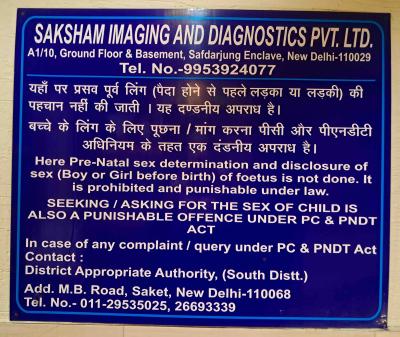
El sábado 18 de noviembre en Delhi estuve en un centro en el que hacen radiografías, ecografías y resonancias magnéticas. En uno de los pasillos vi colgado un cartel que en hindi y en inglés decía lo siguiente:
¨Here Pre-Natal sex determination and disclosure of sex (Boy or Girl before birth) of foetus is not done. It is prohibited and punishable under law.
Seeking/Asking for the sex of child is also a punishable offence under Pre-Conception & Pre-Natal Diagnostic Techniques Act.¨
Traducido al castellano:
¨Aquí no se realiza la determinación del sexo prenatal ni la divulgación del sexo (niño o niña antes del nacimiento) del feto. Está prohibido y sujeto a sanciones según la ley. También es un delito castigado solicitar o preguntar por el sexo del niño según la Ley de Técnicas de Diagnóstico Preconcepcional y Prenatal¨.
Es algo que ya había oído anteriormente: en India es ilegal que los padres sepan en género del bebé que espera una mujer embarazada. Hay una razón para ello. Mejor que explicarlo yo, reproduzco un párrafo de ¨La India por dentro¨, de Álvaro Enterría:
¨Dicho todo esto, también es cierto que nacer mujer en la India trae de entrada muchos inconvenientes, especialmente en las familias pobres. Un niño varón, que traerá dinero a casa y se ocupará de sus ancianos padres, suele ser mejor acogido que una niña, que se irá a otra familia tras llevarse una buena cantidad de dinero como dote. Así, la escolarización de los niños es superior a la de las niñas, pues un buen nivel de estudios es importante para encontrar trabajo más tarde, mientras que una buena boda resuelve la situación de muchas mujeres. La preferencia por hijos varones trae a veces consecuencias trágicas. La tasa de supervivencia de niños varones es más alta que la de niñas. En la India está prohibido indicar el sexo de los futuros hijos por ecografía, pues es relativamente común el aborto de los fetos de niñas (sobre todo en Panjab, curiosamente uno de los estados más prósperos). Mucha gente encuentra un medio de sortear esta prohibición para decidir si guardan al hijo o no dependiendo de su sexo¨.
Este párrafo está sacado de una sección de 10 páginas titulada ¨La mujer y el hombre¨. No es representativo de lo que es toda la sociedad india. Como habéis leído, empieza con ¨dicho todo esto…¨. En líneas anteriores dice por ejemplo que ¨es bastante común ver a mujeres que ejercen papeles de mucha autoridad; esto es así no sólo en el entorno familiar, sino en el social […]. Algunos rishis de la época védica eran mujeres, que entraban en profundas discusiones con los eruditos varones; en la India clásica también había muchas mujeres respetadas por su gran cultura y conocimiento. A diferencia de las epopeyas griegas, donde las mujeres tienen un papel pasivo y secundario, en el Mahabhárata aparecen como fuertes, decididas y de ideas claras, y su actuación tiene una gran importancia en el desarrollo de los acontecimientos […]. Pero recordemos que la India fue gobernada por una mujer, Indira Gandhi, cuando este hecho era excepcional en Europa y América¨.
Este libro de ¨La India por dentro¨ de Álvaro Enterría (fue publicado en 2006 y yo tengo la décimo quinta edición de 2018) es una auténtica joya, una mini enciclopedia de India a la que acudir siempre que se quiera saber más sobre algún aspecto específico de este país y su sociedad.
Pero bueno, resumiendo. Esa ley existe en India desde 1994, me ha parecido curioso y quería compartirlo.
El 20 de julio escribí aquí una entrada sobre la rodilla derecha, que me anda jugando malas pasadas.
Resumiendo:
-Una resonancia magnética del 3 de julio decía que tenía una ¨severa tendinopatía proximal rotuliana con rotura intratendinosa, edema óseo en polo inferior de rótula y alteraciones inflamatorias en grasa de Hoffa adyacente¨.
-El médico en España me recomendó tres chutes de plasma con factores de crecimiento.
-Me los pusieron en India, los días 20 de julio, 29 de julio y 7 de agosto de 2023.
(curiosidad – En el clínica Quirón de Vitoria me dijeron que cada chute de plasma costaba 2.199,44 euros, por tres serían 6.598,32 euros. En India cuesta el chute 15.000 rupias por inyección, unos 164,45 euros, por tres serían 493,35 euros. Una diferencia de 6.104,97 euros, o en porcentaje ponerte chutes de plasma en Vitoria en la Quirón es un 1.337% más caro que en Nueva Delhi).
El traumatólogo de Delhi me dijo que en dos o tres meses podría volver a empezar a correr.
Han pasado ya más de tres meses y sigo igual de mal de la rodilla derecha.
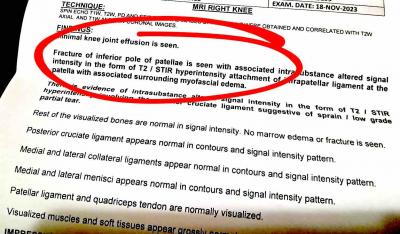
Cada mes me pasaba por la consulta del médico indio para hacer un seguimiento. Este sábado 18 de noviembre, viendo que habían pasado más de tres meses y no había mejoría, me dijo que me hiciera otra resonancia magnética. El resultado:
- Leve efusión en la articulación de la rodilla.
- Fractura en el polo inferior de la rótula con tendinosis en la unión del ligamento infrarotuliano en la rótula.
- Esguince/desgarro parcial de bajo grado en el ligamento cruzado anterior.
Me ha dicho el médico que vamos a esperar tres meses, a ver si se va curando esa fractura de la rótula, y que si no ya veremos si se pone otra de plasma o qué hacemos. Que lo de correr, en unos 6 meses.
Ojalá. Porque tengo un mono de la leche…
Y bueno, para empezar, que me deje de doler la rodilla todos los días sería algo grande…
Y que confirmen que no hay que pasar por quirófano, también es un alivio.
Ah, he comentado los precios de los chutes de plasma en India y en España.
La resonancia:
-En Gasteiz 430 euros.
-En Nueva Delhi 8.000 rupias = 88 euros.
Note: The original entry was written in Spanish here.
This is a translation into English using ChatGPT.
Photos: Ahmedabad (153)
Photos: Kutch (350)
Video (1'51"): Mandvi Beach (Kutch, Gujarat). November 10, 2023.
Video (2'03"): Preparation of mawa @New Bhirandiara tea & mava center (Kutch, Gujarat). November 11, 2023.
Video (3'23"): Great Rann of Kutch (Gujarat). November 11, 2023.
Video (9'29"): Ahmedabad and Kutch (Gujarat). November 10-13, 2023.
Video (1'05"): My prediction for the Cricket World Championship final. November 13, 2023.
Video Relive (2'38"): Kutch (Gujarat). November 10-12, 2023.
Video Relive (2'14"): Ahmedabad (Gujarat). November 13, 2023.
On Sunday, November 12, Diwali, the festival of lights, was celebrated in India. That's why we didn't have classes on Friday, November 10, or Monday, November 13, making it a beautiful 4-day weekend. There was no shortage of plans to make in India, and this time I decided to visit the state of Gujarat. The reason: I wanted to explore the Great Rann of Kutch, a white desert.
Here was the logistics:
Transportation:
- Wednesday, November 9: Indigo Flight 6E2501 Delhi T2 (18:40) – Ahmedabad T1 (20:15). Duration 1h35´.
- Wednesday, November 9: Train 2097 Ahmedabad Jn (23:35) – Bhuj (06:30+1). Duration 6h55´.
- Sunday, November 12: Train 20908 Bhuj (22:35) – Ahmedabad (05:10+1). Duration 6h35´.
- Monday, November 13: Indigo Flight 6E2209 Ahmedabad T1 (21:00) – Delhi T2 (22:35). Duration 1h35´.
Accommodation:
- Night of November 9: On the train from Ahmedabad to Bhuj.
- Night of November 10: In Bhuj, at Kuldip Gadhvi's home (Desert Adventures Kutch).
- Night of November 11: In Bhuj, at Kuldip Gadhvi's home (Desert Adventures Kutch).
- Night of November 12: On the train from Bhuj to Ahmedabad. Afterward, I booked a room at the Hotel Prime (Relief Rd, Ahmedabad).
Guide:
My main interest was to visit the Great Rann of Kutch, a saline desert. I will talk about it later. I was looking for ways to get there, and it seemed easier to do it with a guide than independently.
I found a tour on the website Klook.com that said "4 Days / 3 Nights Tour to the Great Rann of Kutch from Ahmedabad." The dates matched perfectly, so it was perfect. I contacted them but never received a response. I also saw other tours, like this one with Sahjanand Tours that started directly in Bhuj. Or this one from Rannutsavonline that seemed quite expensive.
Digging around, I came across this website (Tripsavvy), to an article that said "How to visit the Great Rann of Kutch: Essential travel guide." They provide very useful information, and I found the following paragraph:
"If you want to visit the Great Rann on a day trip from Bhuj, you can rent a taxi or a motorcycle. Alternatively, there are small group tour packages available.
Opting for a guided tour eliminates the hassle of planning and sightseeing. Kutch Adventures India is based in Bhuj and is dedicated to rural and responsible tourism in the area. The owner, Kuldip, will create a customized itinerary for you, which will include visits to the surrounding artisan villages (for which Kutch is known)."
I started exploring the website https://www.kutchadventuresindia.com/ and liked what I saw.
- A guide concerned about sustainable tourism and the development of local communities.
- The possibility of staying in his home and experiencing a more authentic, local experience.
Here is more information about Kuldip and what he does:
Instagram: https://www.instagram.com/kutch_adventures_india/
Facebook: https://www.facebook.com/Kutch.Adventures
Youtube: https://www.youtube.com/@KuldipGadhvi
I contacted him by email, he responded quickly, and we agreed on the plan.
What you see on the Internet and reality often differs. However, my stay at Kuldip's house exceeded all expectations; it was a real pleasure to spend a few days with him and his wife at their home. If you go to the Kutch area, I recommend 200% that you contact him. He is one of those people who conveys energy, passion for his work, and a true desire to contribute to the development of the region. You really feel welcomed, don´t hesitate in contacting him!
Thursday, November 9, 2023.
The last day of school before the long Diwali weekend, so at school, we dressed in traditional Indian outfits. Here, you can see some photos.
We finished at 4 pm, went home to pick up my backpack, and headed to the airport. For 4 days, I only carried a backpack that I didn't have to check in, so I was traveling light. The flight was uneventful, departing from Delhi at 6:40 pm and arriving in Ahmedabad at 8:15 pm.
On October 14, I had booked a train for that night from Ahmedabad to Bhuj, in first class (1A). Ahmedabad Jn (11:35 pm) - Bhuj (6:30 am the next day). A six-hour and 55-minute train ride, which is quite comfortable in a sleeper berth. When I booked the train, there were no available seats, and I was placed on WL2 (second on the waiting list). Typically, the waiting list tends to move, and before you board the train, your seat is usually confirmed. However, as the days passed, the waiting list didn't move, so I had to come up with a plan B.
I booked an overnight bus with Red Bus from Ahmedabad (11:00 pm) to Bhuj (7:00 am the next day). An eight-hour bus journey, but it also had sleeper berths. While waiting to board my flight in Delhi, I checked the train website and saw that I was still on the waiting list, WL2. Upon landing in Ahmedabad, I received a text message from the train company confirming my seat. So, at the last minute, I had two tickets, one for the bus and one for the train. I chose the train, as it seemed more comfortable to me.
Friday, November 10, 2023.
I arrived at the Bhuj station at 6:30 am and took an autorickshaw to Kuldip's house. He was waiting for me there. Also staying at his house were a very nice Italian couple, Ercole and Ioselita.
Kuldip drove us in his car to visit Mandvi. This is what the Lonely Planet guide says about this city:
"Boats are the raison d'être of Mandvi. This small town, an hour from Bhuj, is a significant shipyard, but not for modern creations of metal, but for large wooden dhows crafted by artisans, commissioned by Arab merchants. The city itself is equally attractive. It suffered less from the 2001 earthquake than Bhuj, so the heart (around Mochi Mazaar) is still lined with beautiful old buildings in faded pastel shades and temples with originally sculpted facades, as if they were vignettes. There are also extensive beaches, such as the stunning, long, clean, and private one near Vijay Vilas Palace, or the public Kashivishvanath beach, with food stalls and camel rides, 2 km from the center, east of the Rukmavati River."
If you imagine Noah's Ark, that would be the term "dhow" mentioned in the paragraph—large wooden ships. When I lived in Dubai (2005-2008), I was always fascinated by the Deira area, the Creek, where these large dhows docked and were in operation, with an impressive flow of goods.
While strolling through the city of Mandvi, we were invited to enter a traditional carpentry workshop. The carpenter, over 80 years old, was carving doors for a Jain temple. He shared his very interesting story; he had worked as an artisan in Oman.
We visited the market, the city, and then went to a beach. I went into the sea for a swim and had to walk almost 100 meters into the water for it to reach my waist.
On the way back to Bhuj, we stopped in a village called Talwana to visit a Jain temple called 72 Jinalaya.
Saturday, November 11.
The plan for this day was to visit the Great Rann of Kutch.
On the way, we stopped at New Bhirandiara tea & mava center and saw how they prepared mawa, also known as khoya. It is a popular dairy product in India, and you can read more about its preparation on Wikipedia under "Khoya." Here are a couple of recipes indicating how to make it (recipe 1 and recipe 2). It was delicious! 😋 In the video, I mention that it is loaded with sugar. That's what I understood, but reading the recipes, I see that's not the case. You can add sugar, but it's not a necessary ingredient.
In Mandvi the day before and at this place, I was surprised to see that people usually drink tea not in cups or glasses but in saucers where we would typically place a coffee cup. A curious custom.
We continued our journey to the Great Rann of Kutch. This is how the Indian-visa-online website describes this white desert:
"The Rann of Kutch is the only white desert in India and one of the largest salt deserts in the world. The world's largest salt deserts are found in various parts, with the white sand patches of Kutch being the only salt desert in the Indian subcontinent.
Located in the western part of India in the state of Gujarat, the Rann of Kutch is divided into two main parts known as the Great Rann and the Little Rann.
Marshy fields divide the area between the India-Pakistan border in the west, with several rivers in the north and the Gulf of Kutch in the south.
Although it is a desert area, the Great Rann of Kutch has evidence of civilization dating back to the Indus Valley period, with one of the largest Harappan sites located in this region of India. It seems that the desert wasn't as harsh as it appears!
And when seen through the eyes of an explorer, the vast salt patches would surely seem much more beautiful than its name suggests.
The Rann of Kutch is a salt desert with vast expanses of salt scattered across large stretches of land by the Arabian Sea. The salt comes from the ocean tides, creating a place that looks like white silk adorned on the land as far as the eye can see. Several salt deserts exist in the world, where, in some places, the salt appears to have a darker texture due to the strong presence of other minerals.
The Great Rann, which constitutes the majority of the Rann of Kutch, is home to many villages scattered throughout its expanse. It's challenging to imagine life in an unfavorable environment like a desert, but the villages of Kutch have maintained great cultural and culinary diversity, reminding us that creativity doesn't have to depend on surrounding situations.
The flat expanses covering the ground with salt and other minerals naturally form as the salt settles with each tide coming from the Arabian Sea, visible in the distance on the horizon. As the sun shines on the salt blankets, one can be amazed by this clear wonder of nature.¨
In summary, these extensive flat surfaces are marshes in summer and salt flats in winter. From November 10 to February 25, 2024, the Rann Festival or Rann Utsav is celebrated in winter. They set up a city with tents, and there's a lot of activity (official website). We were in another area of the salt flats and did not visit the tents. According to the Indian-visa-online guide:
"The tent city of Kutch welcomes several tourists each year to witness the colorful side of Gujarat. A visit to Tent City would mean experiencing cuisine, culture, nature, and people, all together in one place.
The village of Dhordo, located in the Kutch district, welcomes tourists from all over the country and abroad and is the best choice for exploring the area during the festival.
The semi-arid grasslands of the Banni Reserve become a hub for tourists to explore the native culture and food of the region, along with many expeditions and activities available for adventure enthusiasts.
The Rann Utsav or the Rann Festival, as it is called, appears as a confluence of all the beautiful things of Gujarat in one place. As a traveler, it is one of the best ways to experience the western part of India.
The spectacular Rann Festival is the best way to witness the captivating beauty of the salt-inlaid land. The village of Dhordo, located on the border between India and Pakistan, becomes the gateway to experiencing the Kutch marshes.
Days of festivals and musical events showcasing local culture and cuisine paint the dry desert with the bright colors of Gujarat during the three winter months.¨
It's undoubtedly cool, but whenever crowds can be avoided, it's better.
This is how the Lonely Planet describes Kutch:
"Kutch, the Wild West of India, is a geographical phenomenon. Bordered by the Gulf of Kutch and the Great and Little Rann, this turtle-shaped flat territory is a seasonal island. In the dry season, the ranns are vast deserts of dry mud and white salt. With the arrival of the monsoon, they first flood with saltwater and then with freshwater. The salt from the ground sterilizes virtually the entire lower part of the marshes. Only in the scattered 'islands' that emerge above the salt level does thick grass grow, providing fodder for the region's animals. In the villages dotting the arid district of Kutch, various sub-castes and tribal groups live, and their crafts are among the best in the country, especially textiles with exquisite embroidery and mirrors. Despite the tremendous earthquake that devastated several towns in 2001, the tenacious inhabitants of this harsh region have rebuilt their lives and welcome visitors with delight."
Back in Bhuj, we visited three traditional villages that sustain themselves through craftsmanship:
We had lunch in Khavda village. The residents welcomed us with colorful dresses and traditional outfits and great kindness. After lunch, we visited Damabhai's loom. Here is what a sign recounting his story said:
¨Namaste!
My name is Damabhai Marwada. I live in Khavda village 70 km north of Bhuj. I live with my wife, mother, father and my 2 brothers in a joint family. I come from Marwada community living in Khavda for generations and engaged with leather work, seasonal farming and various other manual works. I´am 23 years old (2019) and studied only up to 9th standard and after dropping out of school, I started working in farms which was physically hard and challenging and it´s rain based and the region where I live is dry and rain is un predictable and hardly enough for farming. So 5 years ago, I decided to learn Kharad (tradicitional rug weaving) which has been practiced in my distant family for generations but unfortunately today there are only 3 families left in Kutch who practice this craft on nomadic loom, using sheep and camel wool. For the past 4 years I worked for Tejsibhai (National Award Winner Rug Weaver) in Kukma village (80 km far from my family home) but after getting married last year, I decided to stay closer to my family in Khavda village so that I can develop my small business and stay closer to my family which is very important to me. However Khavda is quite far and out of reach of many visitors (my potential customers). Being a small and independent rug weaver is quite challenging these days when everyone is buying products online or from famous shops/outlets. Fortunately I found this great initiative ¨United Artisans of Kutch¨ where my story and rugs can reach to my potential customers who would admire what I have been creating. I have dream to develop this craft and find space in the market and take this traditional craft to national and international level. I hope you will enjoy seeing my rugs and hopefully someday be my guest at my home in Khavda if you are traveling in Kutch, Gujarat. Thank you.
Damabhai @United Artisans of Kutch
Ps. I design my own rugs following my own understanding of designing and inspiration but I can also create rug/carpet if you have your own unique designs.¨
Excellent initiative by the United Artisans of Kutch. Here is their website:
https://sites.google.com/site/unitedartisansofkutch/home
Facebook: https://www.facebook.com/UnitedArtisansOfKutch/
Instagram: https://www.instagram.com/united_artisans_of_kutch/
This small carpet will decorate a corner of my garage in San Martín de Don.
The second village we visited was Gandhi un Gaam. They had several craft shops. In one of them was a woman, Kheta Ben, of a certain age, who had once appeared on a postage stamp issued by India Post dedicated to rural women of India.
The third village we visited was Nirona. The characteristic craft of this village was lacquered wood, wooden tools painted using a curious method. I'll explain it below, translating from a sign that was there and from this website: https://www.khamir.org/crafts/lacquered-wood
"Lacquered Wood Craft:
The art of making lacquer-decorated wooden objects has been practiced in India for centuries. In Kutch, this craft is the domain of the semi-nomadic Vadha community.
The Vadhas traditionally worked on the move, going where their skill was needed in the villages bordering the Great Rann of Kutch, and producing vibrantly colored wooden furniture and home accessories. They developed their skills using forest products and the colored stones/minerals they found in their environment.
The kaleidoscopic craft of Kutch.
Today, turned lacquered wood is a declining craft in Kutch, practiced only by a small number of families. Craftsmen depend on sales made during the limited tourist season of Kutch. The lack of exposure and access to a stable market only worsens an already low quality of life, and many younger community members refuse to continue with the livelihood.
Lacquer, a material obtained from insect resin, has been used in Indian craftsmanship for centuries. Colored lacquer is applied to wood through heat by turning it with a manual lathe. In the process, the craftsman maneuvers the lacquered colors to create handcrafted patterns in kaleidoscopic designs. This type of lacquered pattern is found only in Kutch.
Turned lacquered wood is practiced using simple tools: a homemade lathe, a rope attached to a bow, and sticks of colored lacquer. Each lathe is bounded by two iron rods that bend toward each other fixed to the ground. The distance between them depends on the length of the wood the craftsman is turning; the wood must be securely held between the pointed ends of the rods. The craftsman begins by carving the wood. Once the wood is carved into a product, craftsmen apply lacquer to the wood to create kaleidoscopic color patterns, unique to Kutch. Traditionally, lacquer was colored with vegetable dyes. Now, craftsmen use brightly colored chemical dyes."
We watched a craftsman perform the process. Afterwards, they showed us several items they had made, and a lacquered wooden spoon, fork, and rolling pin will fly to Spain at Christmas. As night fell, families began to cook outdoors over fires. The dinner seemed very simple, mainly consisting of roti (a type of flatbread). There was a constant clanging sound from a boy with some mental illness who continuously struck a metal object with a stick.
From there, we returned to Bhuj. That night, Kuldip's son and the neighborhood kids enjoyed setting off a bunch of fireworks and pyrotechnics for Diwali.
Sunday, November 12.
We dedicated this day to exploring Bhuj. Here's how Lonely Planet describes it:
"This is Gujarat's most fascinating city, with ancient palaces full of treasures, grand dining halls, and an old town that is a bustling network of narrow, lively alleyways. There are also a couple of interesting museums and plenty of shops selling high-quality local textiles.
Bhuj is also a springboard to visit the surrounding villages, the beautiful natural surroundings of the Great Rann, and the textile world that attracts curious visitors from around the globe.
The Rajputas Jadeja, who took control of Kachchh in 1510, made Bhuj their capital 29 years later, and it has been the most important city in Kachchh since then (and the capital of the region). In 2001, a massive earthquake almost completely destroyed Bhuj. Although nearly rebuilt, the city lost much of its historical architecture, and some palaces still bear scars from the disastrous event."
In Bhuj, we visited:
- Prag Mahal: Cracks from the 2001 earthquake are still visible. The Maharaja's taxidermy collection is in a sorry state, with the heads of animals repaired with packing tape (I have never seen worse restoration in my life :) Several scenes from the movie Lagaan, starring the great Aamir Khan, were filmed here. Lagaan, which I loved, was nominated for Best Foreign Language Film at the 2012 Oscars.
- Aina Mahal: It was closed at noon, and I didn't see it.
- Cenotaph Rao Lakhpatji Chhatri.
From there, we walked to Hamirsar Pond and Rajendra Park.
We had a thali lunch at the Green Rock restaurant.
After lunch, we split up. Ercole and Ioselita went to Aina Mahal (which they said is amazing) and to a market, while I:
- Visited the Kutch Museum, but a sign in Gujarati or Kutchi indicated that it was closed for Diwali, from the 12th to the 15th.
- Smritivan Museum in Memory of the 2001 Earthquake. I found it incredible, both in terms of architecture and content. It's a top-notch museum globally. They have Virtual Reality glasses and even an earthquake simulator. Impactful.
- From there, I walked to Sunset Point, a place to watch the sunset. But I arrived at night, enjoying the city lights.
Back to Kuldip's house. We had dinner, and a shepherd he knew came to visit to celebrate Diwali. After dinner, I took a tuk-tuk to the bus station to catch the Sayajinagri Express (20908) train from Bhuj (22:35) to Ahmedabad (05:10+1).
Once again, I recommend that if you go to that area, stay with Kuldip. He will take you to see traditional villages, and you will experience local culture firsthand. He's fantastic, and he's doing a lot for the people there!
Monday, November 13.
The train to Ahmedabad arrived at 5:10 am. I had noted that it took 6 hours and 35 minutes, and I mistakenly thought that was the arrival time. So, I set the alarm for 6 am. At 5 am, a fellow passenger woke me up, telling me I was in his berth. Still half-asleep, I showed him my ticket, telling him that I was in my berth, H1, E13. Then I realized we were already in Ahmedabad, and that's why he had my berth. He was boarding in this city, and I had to get off quickly.
Arriving at these early hours, I had made a reservation at the Prime hotel, and I went to sleep for a while before heading out to explore. This is what Lonely Planet says about the city:
"The largest city in the state, also called Amdavad, Ahmadabad, or Ahemdavad, impresses with both good and bad. With traffic, noise, and air so thick you can almost chew it, Ahmedabad can be a bit overwhelming. But the city soon captivates with its incredible architecture—from centuries-old mosques and mausoleums to contemporary and avant-garde design—a labyrinthine old town, some excellent museums, good restaurants, and a lively street food scene, for which it was the first city in India to be declared a UNESCO World Heritage Site.
The old town, on the east side of the Sabarmati River, was surrounded by a 10 km wall, of which 15 gates still remain. The new city, on the west bank of the river, has wider streets, several major universities, and numerous middle-class neighborhoods."
The Italians had spoken highly of a walking tour of the city organized by the city. You can find information here: https://heritagewalkahmedabad.com/.
This website also provides useful information about what to see: https://www.amdavadcitysights.com/
I did the tour on my own. I reached an agreement with the auto-rickshaw driver GJ-1 4666 BX to take me to the following places:
- Adalaj Stepwell. Lonely Planet describes it as follows: "The Adalaj Vav, 19 km north of Ahmedabad, is among Gujarat's finest stepwells. Built by Queen Rudabai in 1498, it has three entrances leading to a huge platform resting on 16 pillars with corners marked by small shrines. The octagonal well has five levels of depth and is adorned with exquisite stone carvings (including erotic ones)¨.
- Narendra Modi Stadium, or Motera Stadium. It is the largest stadium in the world, with a capacity for 132,000 people, and on Sunday, November 19, it will host the final of the Cricket World Cup, India vs. Australia. I hope the host country takes the cup.
- Gandhi Ashram. Lonely Planet describes it as follows: "Sabarmati Ashram - In peaceful and shaded gardens on the west bank of the Sabarmati River, this ashram was Gandhi's headquarters from 1917 to 1930 during the struggle for independence. It is said that he chose the location because it was between a jail and a cemetery, and any satyagrahi (nonviolent resistor) was destined to end up in one or the other. Gandhi's spartan quarters are preserved, and a museum shows a moving and informative chronicle of his life and teachings. From here, on March 12, 1930, he and 78 companions initiated the famous Salt March to Dandi, in the Gulf of Cambay, as a symbolic protest; Gandhi vowed not to return to the ashram until India was independent. The ashram was dissolved in 1933 and later became a center for social assistance to dalits and rural residents. After his death, some of his ashes were scattered in the river in front of the ashram."
- Hutheesing Jain Temple. Lonely Planet describes it as follows: "Outside Delhi Gate, this is one of Ahmedabad's 300 derasars (Jain temples). Although you may have seen some, this one will amaze you with its delicate carvings of deities, flowers, and celestial maidens in white marble. It was erected in 1848 and was dedicated to Dharamanath, the 15th tirthankar (great Jain master); each of the 52 minor shrines in the courtyard houses his image with jeweled eyes. The caretaker may allow you to go to the rooftop."
- Hazrat Bai Harir Stepwell and Mosque.
- Riverfront Flower Park and Atal Pedestrian Bridge.
That's what the day allowed because it was time to go to the airport. Indigo flight 6E2209 Ahmedabad T1 (21:00) – Delhi T2 (22:35).
Four very well-utilized days. India is a marvel, with fantastic things to see wherever you go.